

Read the article summary · From 10 minutes to about 3 minutes
A 3-minute overview: Understand money distress, begin with available money and income, explore your habits, and use TC Life's tools to plan and review changes.
Why money can feel difficult after a setback
Financial hardship can affect both your circumstances and your relationship with money. Checking a balance, making a purchase, or planning ahead may bring fear, shame, or uncertainty. Financial trauma is a term used to describe lasting distress connected to difficult money experiences. Here, it is a descriptive term, not a diagnosis.
Research connects money beliefs, financial strain, and emotional experiences with financial behavior and well-being. It does not establish that a planner treats trauma. Avoidance or difficulty making decisions can have different explanations; recognizing a pattern does not diagnose you.
Start with your money and habits
TC Life's starting point is understanding what you have, how money is coming in, and how you are using it. These eight steps offer a practical way to begin:
- Check available money. List bank balances and cash. Account for pending purchases and mark reserved funds. Keep available credit separate from income.
- Understand incoming money. List sources, expected amounts, and dates. Separate confirmed income from possible income, especially when earnings vary.
- Review recent spending. Look at a manageable period, such as seven days. Notice basic needs, commitments, flexible purchases, and fees without judging every purchase.
- Identify a pattern. Notice repeated choices and what influences them. Also recognize habits already helping you. Ask what makes a decision easier or harder.
- Plan for the money available. Look ahead to your next confirmed income. Include basic needs and approaching obligations, then see what remains. If there is a shortfall, make it visible.
- Try one habit change. Check a balance before a flexible purchase, review a subscription, or record cash spending. Choose something specific enough to evaluate.
- Choose a useful tool. Begin with the question you want to answer rather than completing every planner at once.
- Review and return. Ask what came in, where it went, and whether your change helped. After an interruption, resume with current information.
A low balance is not proof of poor habits. When income cannot cover expenses, organizational tools can reveal the gap, but they cannot supply missing income. Assistance, additional income, or payment arrangements may also be relevant.
Choose your tools and format
Budget Reset helps organize income and expenses. Weekly Check-in supports review, and Confidence Builder supports reflection on your decisions. Bill Tracker, Savings Goal, and Debt Payoff Planner support specific tasks when relevant.
The free digital tools work in your browser. Financial entries are not shared with TC Life, LLC; contact information submitted through the access form is collected separately.
The paid PDFs provide copies to complete and keep. Automatic calculations require Adobe Acrobat Reader. You can also print the planners, write your entries by hand, and calculate paper totals yourself.
See what changed with Progress Review
Progress Review reads completed, saved, supported TC Life PDFs. One provides a snapshot; two or more dated copies of the same planner allow comparisons of supported information. Save interactive fields intact. It cannot read handwriting from scans or photos; transfer handwritten entries into a supported PDF first. The review runs in your browser without sending financial records to TC Life or an AI service.
Choose your next step
The tools support organization and reflection, not trauma treatment. If distress affects daily life, consider qualified support. Begin with one balance, income source, or spending pattern you want to understand.
Your money. Your plan. Your next step.

Financial Trauma: Understanding Money Distress and Where to Begin
By Nataya J. Crawford, founder of TC Life, LLC
After a financial setback, you may be focused on a more immediate question: how do I make the money I have last?
You may want to save while feeling afraid to spend money on something you need. Or you may avoid checking an account because you already expect the numbers to bring disappointment.
When money has been connected to hardship, loss, or control, financial planning can involve more than calculations.
Financial trauma is a term used to describe lasting distress connected to difficult money experiences. This guide explores that distress, explains what research can tell us, and offers manageable ways to begin organizing your finances.
At TC Life, our starting point is the money you have, how money is coming in, and the habits shaping how you use it. From that picture, you can make a plan for your needs, commitments, and goals.
**This article provides general education and practical organizational ideas. It does not diagnose or treat trauma or provide individualized financial advice.
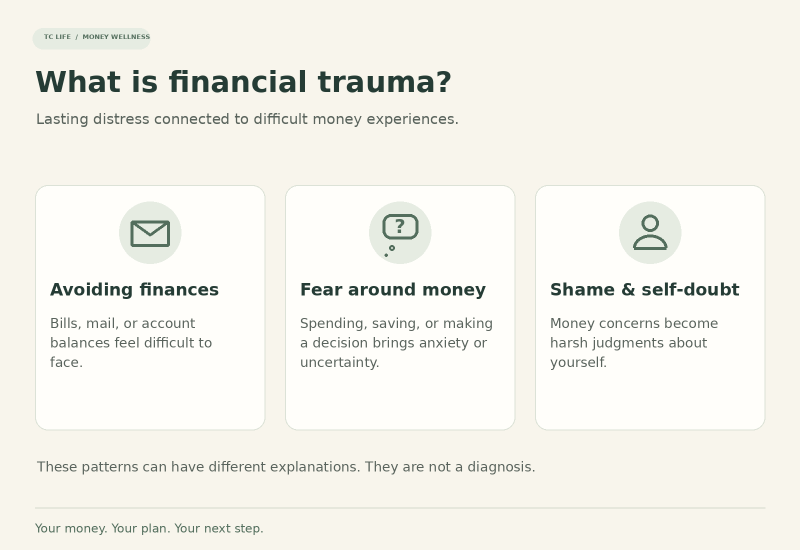
What is financial trauma?
In financial counseling and therapy, the term financial trauma is used to describe how distressing experiences involving money can continue to affect someone's sense of security and financial behavior.
Financial control, instability, and coercion can leave people fearful of making decisions even after their circumstances change. An AFCPE article by financial counselor Heidi Clemons describes these patterns among people leaving abusive relationships or controlling groups.
Here, “financial trauma” is a descriptive term, not a diagnosis for readers to give themselves.
Financial stress and lasting distress can overlap. There is no simple test based on income, symptoms, or how long a worry lasts that tells you which label applies. You can seek support without first deciding what to call your experience.
What experiences can affect your relationship with money?
You may be trying to manage finances after a job loss, a major expense, a separation, or a period when basic needs were difficult to cover. You may also be learning to make independent money decisions after someone else controlled access to your earnings or accounts.
These are situations to consider when reflecting on your money history, not a checklist of events that automatically cause trauma.
The practical problem may still be present. If your income does not cover your expenses, a change in attitude cannot close that gap by itself. Organizing information can help you identify what is happening and what assistance or decisions might be relevant.
How money distress can show up
Patterns discussed in financial counseling include:
- Avoiding mail, bills, or account balances.
- Feeling anxious or stuck when making money decisions.
- Moving between impulsive spending and severe restrictions on spending.
- Distrusting financial institutions.
- Feeling shame or doubting your own judgment.
These patterns have different possible explanations. Recognizing yourself in this list does not establish that you have trauma or any particular mental health condition.
A more useful starting question may be: “What happens when I try to deal with money, and what kind of support would help?”
What does research tell us?
Research gives us reasons to take the emotional side of money seriously.
Money beliefs are connected with financial circumstances. A 2011 study by Klontz and colleagues examined 72 money beliefs among 422 participants. It identified four belief patterns, three of which were associated with income and net worth. This was research on money beliefs, not a test for financial trauma.
The stress people feel matters alongside the financial strain itself. A 2017 study by Asebedo and Wilmarth, using Health and Retirement Study data, found that depression scores rose as respondents' reported stress response to financial strain increased. The findings describe relationships in that study; they do not mean financial hardship can be solved by thinking differently.
Trauma and financial behavior can intersect. A 2018 paper by Ross and Coambs explored that relationship through a clinical discussion and case vignette. Together, these sources support considering both financial circumstances and emotional experiences. They do not establish that TC Life's tools treat either trauma or depression.

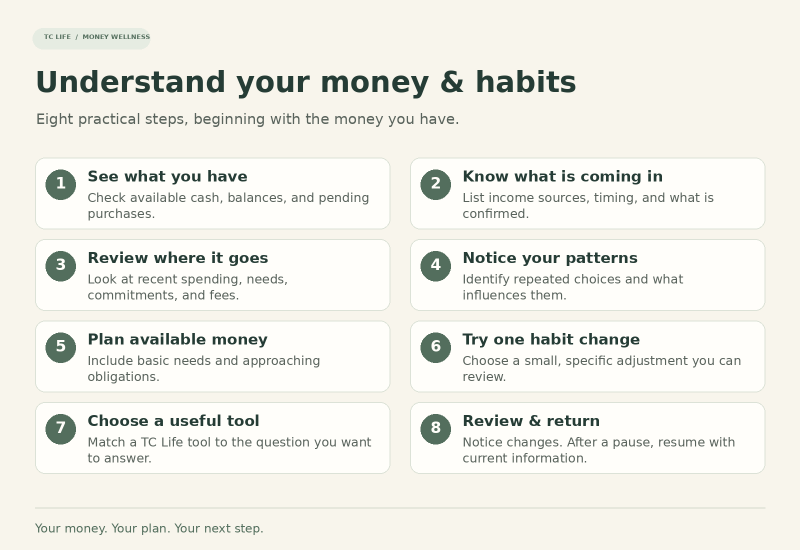
Eight practical steps to understand your money and habits
After a financial setback, you may be focused on making limited money last. A useful starting point is understanding what you have, what is coming in, and how you are using it.
These steps offer a way to build that picture. They support organization and reflection; they are not a treatment for trauma.
1. Take stock of the money you have today
Write down your bank balances and cash on hand. Check pending transactions so you do not count money already committed to a purchase.
Keep borrowed money and available credit separate from income. If some funds are reserved for a specific purpose, mark that clearly.
You are establishing a starting amount you can understand, without judging whether it is “enough.”
2. Look at how money is coming in
List each income source, the amount you expect to receive, and when it is expected.
That may include wages, benefits, business income, or other support. Separate confirmed income from money you hope to receive. For variable income, record the uncertainty rather than treating every month as identical.
Example only:
| Money source | Amount | Timing | What you know |
|---|---|---|---|
| Current available money | $120 | Today | Balance checked after pending transactions |
| Part-time wages | $250 | October 16 | Expected take-home pay |
| Possible sale | $40 | Unknown | Not confirmed; excluded from the spending plan |
The example does not mean $410 is available today. It shows $120 available now, $250 expected later, and $40 that remains uncertain.
3. Notice where your money has been going
Review a manageable period, such as the past seven days. Use transactions, receipts, and cash purchases where you can.
Group spending in a way that helps you understand it: basic needs, bills and other commitments, flexible purchases, and fees.
The purpose is to notice what happened. A small purchase is not automatically a bad choice, and a low balance is not proof of poor habits.
4. Identify a pattern you want to understand
Look for something that repeats.
Do you make purchases without checking what is available? Do convenience costs increase when you are tired? Do subscriptions continue after you stop using them? Do you avoid your accounts until you are unsure what remains?
Also notice what is working: checking a balance before buying, comparing prices, or setting money aside intentionally.
Ask, “What tends to happen, and what makes that choice easier or harder?” You are looking for useful information, not a reason to criticize yourself.
5. Decide how the money you have will be used
Make a short plan for the period before your next confirmed income.
Account for basic needs, essential services, approaching due dates, and other commitments. Then see what remains for flexible spending or a goal you choose.
If the amounts do not fit, make the gap visible. A shortfall may call for assistance, more income, or a conversation about payment arrangements. It cannot always be solved by changing habits.
Understanding your money first gives you a clearer basis for decisions about bills, spending, and savings.
6. Choose one habit to adjust
Pick a change connected to the pattern you noticed.
You might check available money before a flexible purchase, pause before buying something unplanned, review one subscription, or record cash spending for a week.
Make the change specific enough to try. You can evaluate whether it helped without committing to an entirely new routine.
7. Use the tool that fits this stage
For this approach, TC Life's Budget Reset, Weekly Check-in, and Confidence Builder are natural starting points.
| What you want to understand or practice | A TC Life tool to explore |
|---|---|
| How income and expenses fit together | Budget Reset |
| What happened with your money this week | Weekly Check-in |
| How you feel about your decisions and progress | Confidence Builder |
| What bills and due dates belong in your plan | Bill Tracker |
| How a savings goal could fit your circumstances | Savings Goal |
| What debt information you want to organize | Debt Payoff Planner |
| What has changed between completed, dated TC Life PDF records | Progress Review |
Choose according to your situation. An approaching deadline may make bill information important immediately; a savings or debt-planning task may be useful at another point.
8. Review what changed and return to current information
At your next check-in, ask:
- What money came in?
- Where did it go?
- Did the habit change help?
- What do I want to adjust?
If you have completed, saved TC Life PDFs, the TC Life Progress Review can help you review a record or compare supported information across dated copies of the same planner. The section below explains how.
If you miss a week, resume with what is true now. Review older information when it would help answer a specific question.
The aim is to understand your money well enough to make deliberate choices, with a process you can return to after interruptions.
Use Progress Review to see what has changed
A money plan becomes more useful when you can return to it and see what is different.
TC Life's Progress Review works with completed, saved copies of supported TC Life PDFs. One completed PDF provides a snapshot. Two or more dated copies of the same planner allow you to compare supported information across time.
For example, you might compare two Budget Reset records to review changes in the income and expenses you entered. A difference is something to explore, not an automatic judgment that you succeeded or failed.
To use it:
- Complete a supported TC Life PDF with your own information and the record date.
- Save the filled PDF with its interactive fields intact.
- Open TC Life Progress Review and select your saved PDF files.
- Review the available comparisons, milestones, and suggested next steps.
Use consistent time periods and categories when comparing records. Leave unknown amounts blank rather than making up numbers. Progress Review reads saved interactive PDF fields; it does not read handwritten numbers from paper, photographs, or scanned pages. If you complete a planner by hand, type those entries into a supported TC Life PDF and save it before using Progress Review. Files created through “Print to PDF” may lose the fields the reviewer needs.
The review takes place in your browser; your PDFs and financial entries are not sent to TC Life, LLC or an AI service. The tool supports reflection on the records you provide. It does not diagnose trauma or measure emotional recovery.
Free digital tools or downloadable PDFs?
TC Life offers free browser-based planning tools and downloadable PDF planners. Progress Review connects the saved PDF records with an online review of the information you entered.
The free digital tools let you explore your finances in your browser. Your financial entries stay in that browser and are not shared with TC Life, LLC. Contact information submitted through the access form is collected separately.
The paid PDF collection provides downloadable planners to complete and keep. Where a PDF includes automatic totals, those calculations require Adobe Acrobat Reader. Browser and phone viewers may not support every interactive feature; review the product's compatibility information before purchasing. You can also print the planners and write in your entries by hand. On paper, calculate the totals yourself; automatic calculations apply only to the digital PDF in Adobe Acrobat Reader.
Explore the free Money Wellness Tools or view the Money Wellness Essentials Collection on TrendyCrest.
You can also open Progress Review when you have a completed, saved supported TC Life PDF to review.
TrendyCrest is the online marketplace owned and operated by TC Life, LLC.
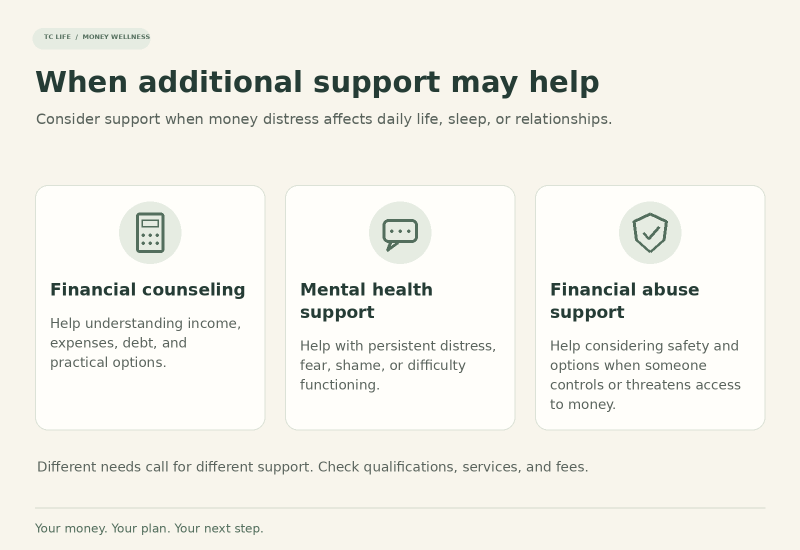
When additional support may help
If money-related distress is affecting your daily life, sleep, relationships, or ability to make decisions, consider speaking with a licensed mental health professional. Practical financial counseling may help alongside that support.
If another person controls your access to money or threatens you over financial decisions, an advocate experienced in abuse can help you consider your options safely.
For immediate emotional support in the United States, you can call or text 988 or use the 988 Lifeline's online chat. The service is available around the clock.
Frequently asked questions
Do I need to decide whether I have financial trauma before using these tools?
No. You can use organizational tools because you want a clearer view of your finances. A label is not required.
Can budgeting tools heal financial trauma?
TC Life's tools support organization, planning, and reflection. They are not treatments for trauma and do not replace mental health care.
What if I cannot afford to save right now?
A savings goal does not have to be your starting point. You can begin by understanding the money you have, how income is coming in, and where your spending is going. A tool helps describe your situation; it does not require you to have money available for every goal.
Do I need several PDFs to use Progress Review?
One completed, supported PDF can provide a snapshot. To compare changes over time, use two or more dated copies of the same planner. Progress Review needs saved interactive PDF field data. It cannot read handwritten numbers in a scan or photo; transfer handwritten entries into a supported TC Life PDF and save the filled file first.
What if I stop using the tools?
You can return to the information that matters now. Update amounts and dates, then choose what you want to work on next.
Begin with one thing you want to understand
You do not have to leave this page with a complete financial plan.
Choose one balance to check, one income source to confirm, or one spending pattern to understand. If you already have saved planner records, you can use Progress Review to explore what has changed. Decide whether you want a tool, more information, or another person's support.
That gives you a place to begin—and a place to return.
Your money. Your plan. Your next step.